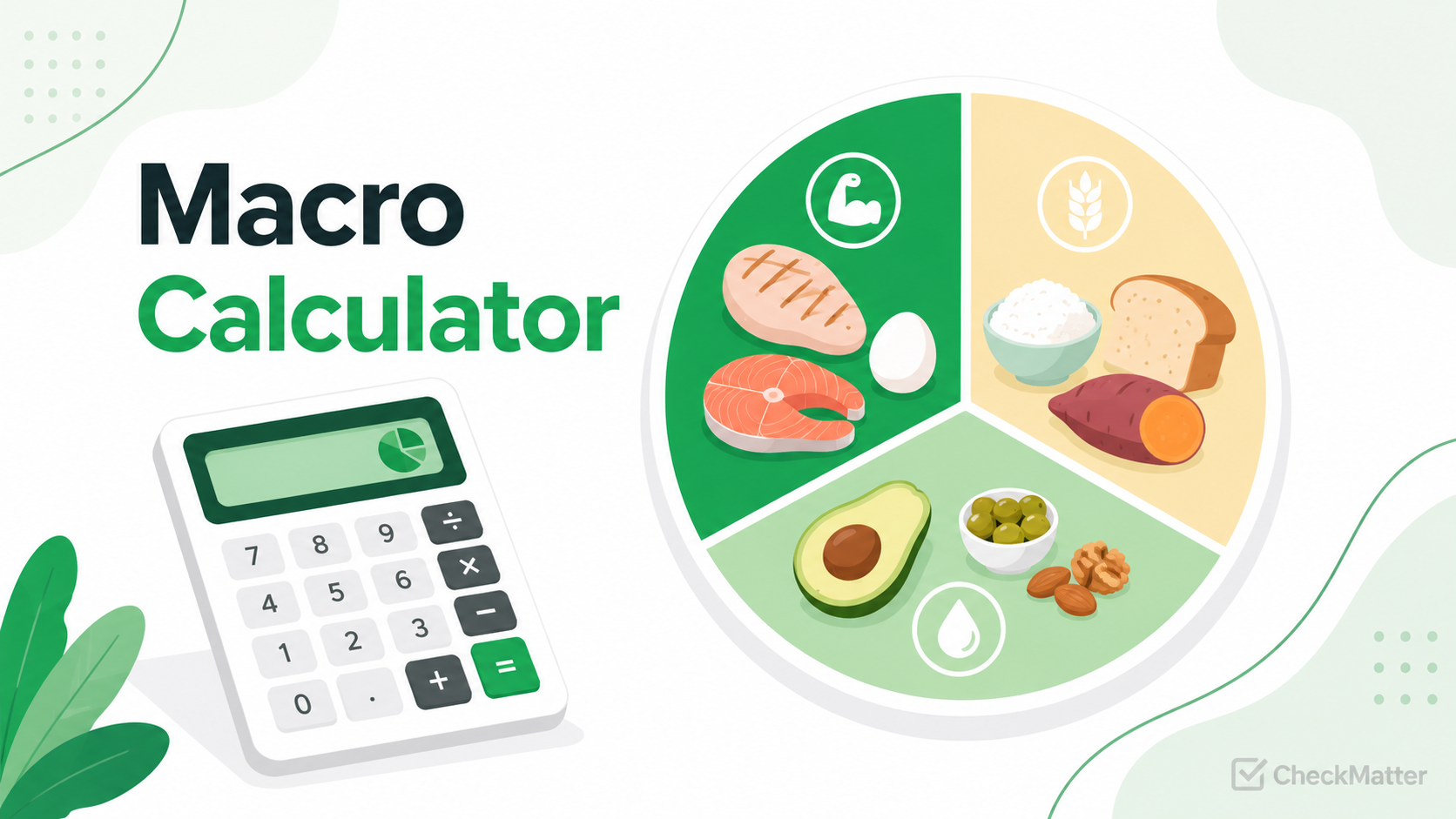
Knowing your daily calorie target is only half the picture — a macro calculator tells you how to split those calories between protein, carbs, and fat so the number on the scale actually moves in the direction you want. Two people eating the same 2,000 calories can get very different results if one is mostly carbs and the other is protein-forward, especially when the goal is losing fat while keeping muscle, or gaining size without piling on excess fat.
Start With Your Calorie Number
Before you can split macros, you need a baseline. That starts with your Total Daily Energy Expenditure (TDEE) — the calories you burn in a day including activity — which you can estimate using CheckMatter’s BMR & Calorie Calculator. From there, a macro calculator takes that daily calorie number and divides it into grams of protein, carbohydrate, and fat based on your goal: cutting, maintaining, or bulking.
If you’re not sure where your weight currently stands relative to a healthy range, checking your BMI Calculator result first can help you set a realistic calorie target before you even get to the macro split.
How a Macro Calculator Splits Your Calories
Each gram of protein and carbohydrate provides about 4 calories, while each gram of fat provides about 9 calories. A macro calculator uses your chosen percentage split and your total calories to back into grams. For example, on a 2,000-calorie target with a 30% protein / 40% carb / 30% fat split:
- Protein: 30% of 2,000 = 600 calories ÷ 4 = 150 grams
- Carbohydrate: 40% of 2,000 = 800 calories ÷ 4 = 200 grams
- Fat: 30% of 2,000 = 600 calories ÷ 9 ≈ 67 grams
The same 2,000 calories, at a 40% protein / 30% carb / 30% fat split for a fat-loss phase, would instead work out to 200 grams of protein, 150 grams of carbs, and about 67 grams of fat — noticeably more protein for the same total calories, which is the whole point of splitting your intake this way rather than just counting total calories alone.
Common Macro Splits by Goal
- Fat loss: Roughly 40% protein, 30% carbs, 30% fat — the higher protein share is generally intended to help preserve lean muscle while in a calorie deficit.
- Maintenance: A more balanced 30% protein, 40% carbs, 30% fat split.
- Muscle gain: Around 30% protein, 45% carbs, 25% fat, with the extra carbohydrate intended to support training volume and recovery.
These are common starting points, not fixed rules — individual needs vary by activity level, training style, and how your body responds over a few weeks of tracking.
Protein: The Number Most People Underestimate
A frequently cited range for people who train regularly is about 1.6 to 2.2 grams of protein per kilogram of body weight per day. For a 70 kg (154 lb) person, that’s roughly 112 to 154 grams of protein daily — often noticeably higher than what a typical diet provides without deliberate planning. A macro calculator makes this concrete by translating a percentage or a per-kilogram target directly into grams you can track at each meal, rather than leaving it as an abstract guideline.
Adjusting Your Split Over Time
Macros aren’t meant to be set once and forgotten. As your weight, activity level, or goal changes, recalculate your TDEE and rerun the split. A good rule of thumb: reassess every 4–6 weeks, or whenever your weight has shifted by more than a couple of kilograms, since your calorie needs change as your body weight changes.
Key Takeaways
- A macro calculator divides your total daily calories into protein, carb, and fat grams based on your specific goal.
- Protein and carbs provide about 4 calories per gram; fat provides about 9 calories per gram.
- Higher protein splits are common during fat loss to help protect lean muscle mass.
- Recalculate your split every few weeks as your weight and activity level change.
The Dietary Guidelines for Americans, published by the U.S. Department of Health and Human Services, sets Acceptable Macronutrient Distribution Ranges of roughly 10–35% of calories from protein, 45–65% from carbohydrate, and 20–35% from fat — a useful reference range to check your own split against before you commit to it.
FAQ
Do I need to hit my macro targets exactly every single day?
No. Being reasonably close most days matters far more than hitting an exact gram target every day; weekly averages are a more realistic way to track progress.
Is a higher protein split necessary for everyone?
Not necessarily — it’s most commonly recommended during a calorie deficit to help preserve muscle, but people focused purely on general health may do fine with a more balanced split.
How is a macro calculator different from just counting calories?
Counting calories alone tracks quantity; a macro calculator also tracks composition, which affects satiety, muscle preservation, and energy levels during training.