
Type the same expression into two different calculators and you can sometimes get two different answers. That’s not a bug. It’s almost always a disagreement about the order of operations, the set of rules that decides which part of a calculation gets solved first. Most people learned it in school as PEMDAS or BODMAS and never thought about it again, until a viral “solve this” math problem or a mismatched receipt total brings it back. Here’s what these rules actually are, why calculators sometimes handle them differently. How to avoid getting tripped up by them.
What the Order of Operations Actually Is
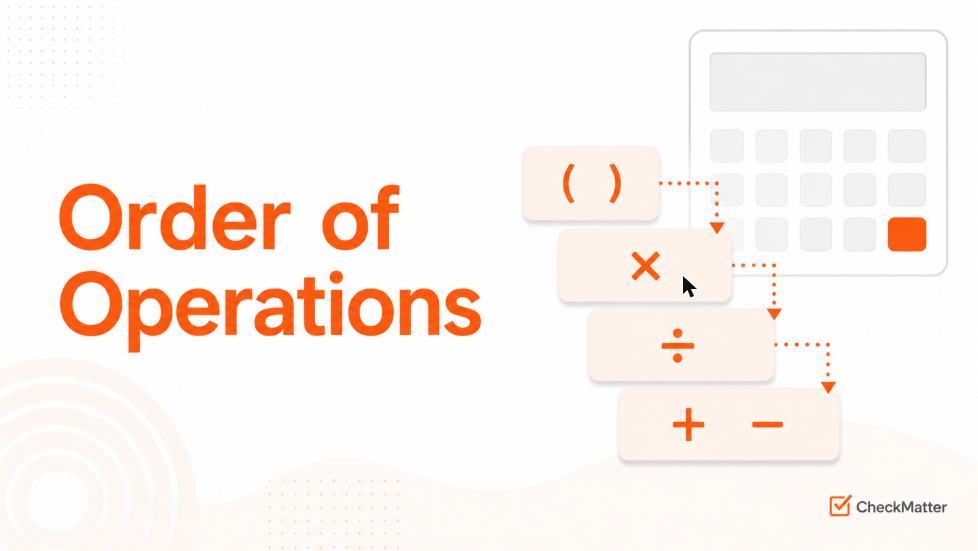
The order of operations is the agreed sequence for evaluating a mathematical expression that mixes multiple operations: parentheses first, then exponents, then multiplication and division (evaluated left to right, at equal priority), then addition and subtraction (also left to right, at equal priority). In the US this is usually remembered as PEMDAS (Parentheses, Exponents, Multiplication, Division, Addition, Subtraction). In the UK, India, and several other countries it’s taught as BODMAS (Brackets, Order, Division, Multiplication, Addition, Subtraction). The acronyms differ, but the underlying rules are identical — just a different mnemonic for the same sequence.
Why Two Calculators Can Give Different Answers
Most modern scientific calculators, including the Scientific Calculator, follow the standard PEMDAS/BODMAS rules correctly and consistently. Disagreements almost always come from one of three places: an older or very basic calculator that evaluates strictly left to right with no operator priority at all, an ambiguous expression that different tools interpret differently (more on this below). A typing mistake where a parenthesis was left out. If you ever see two answers to what looks like the same problem, the first thing to check is whether the expression was actually typed identically into both. A missing bracket changes everything.
The Classic Example That Breaks the Internet
Take an expression like 8 ÷ 2(2 + 2). Solve the parentheses first: 2 + 2 = 4, leaving 8 ÷ 2(4). This is where people split into two camps. One group treats “2(4)” as a single multiplication step tied directly to the division, working strictly left to right: 8 ÷ 2 = 4, then 4 × 4 = 16. The other group treats the “2(4)” as implied multiplication that should be resolved before the division, giving 8 ÷ 8 = 1. Under strict, formally-taught convention, multiplication and division share equal priority and are evaluated left to right. Supports the first answer (16). But the ambiguity around implicit multiplication next to parentheses is exactly why this particular expression is genuinely disputed among mathematicians, not just confused students.
Implicit Multiplication: The Real Gray Area
“Implicit multiplication” is when two terms are placed next to each other with no operator between them, like 2(4) or 3x. It’s understood to mean multiply. Most style guides agree that implicit multiplication should be evaluated before explicit division or multiplication written with a symbol. Not every calculator or programming language honors this convention the same way. This single gray area accounts for the large majority of “why did I get a different answer” moments people run into. The safest habit, especially when typing an expression into any calculator or spreadsheet, is to add parentheses around anything you mean to be evaluated as one unit. Turning 8 ÷ 2(2+2) into 8 ÷ (2(2+2)) or 8 ÷ 2 × (2+2) removes the ambiguity entirely.
How to Avoid These Calculator Mistakes
A few habits prevent most miscalculations like these: use parentheses liberally rather than relying on implied priority, double-check any expression with mixed division and multiplication by adding brackets around the part you intend to group. When in doubt, break a long calculation into smaller steps rather than typing one long string of operations. If you’re doing repeated calculations with functions, exponents. Trigonometry, a proper scientific calculator that clearly shows each step as you enter it is far more reliable than a basic four-function calculator or typing directly into a search bar.
Key Takeaways
- The order of operations is: parentheses, exponents, multiplication/division (left to right), addition/subtraction (left to right).
- PEMDAS and BODMAS are different mnemonics for the exact same underlying rules.
- Most “wrong answer” disagreements come from ambiguous implicit multiplication, not a broken calculator.
- Adding extra parentheses around any group you intend to be evaluated together removes the ambiguity entirely.
FAQ
Is PEMDAS the same as BODMAS?
Yes. Both describe the exact same sequence of steps — the letters just stand for regional naming differences (Parentheses/Brackets, Exponents/Order).
Do multiplication and division really have equal priority?
Yes. Under the standard rules, multiplication and division are evaluated together, left to right, in the order they appear. Neither one automatically goes first.
Why do calculators sometimes disagree on the same expression?
Usually because the expression itself is ambiguous (like implicit multiplication next to a division sign). Because one calculator is a basic model that doesn’t apply operator priority at all.
For a deeper technical history and international variations of these conventions, see Wikipedia’s entry on the order of operations. Try working through examples yourself with the Scientific Calculator, or browse more guides on the CheckMatter blog.