
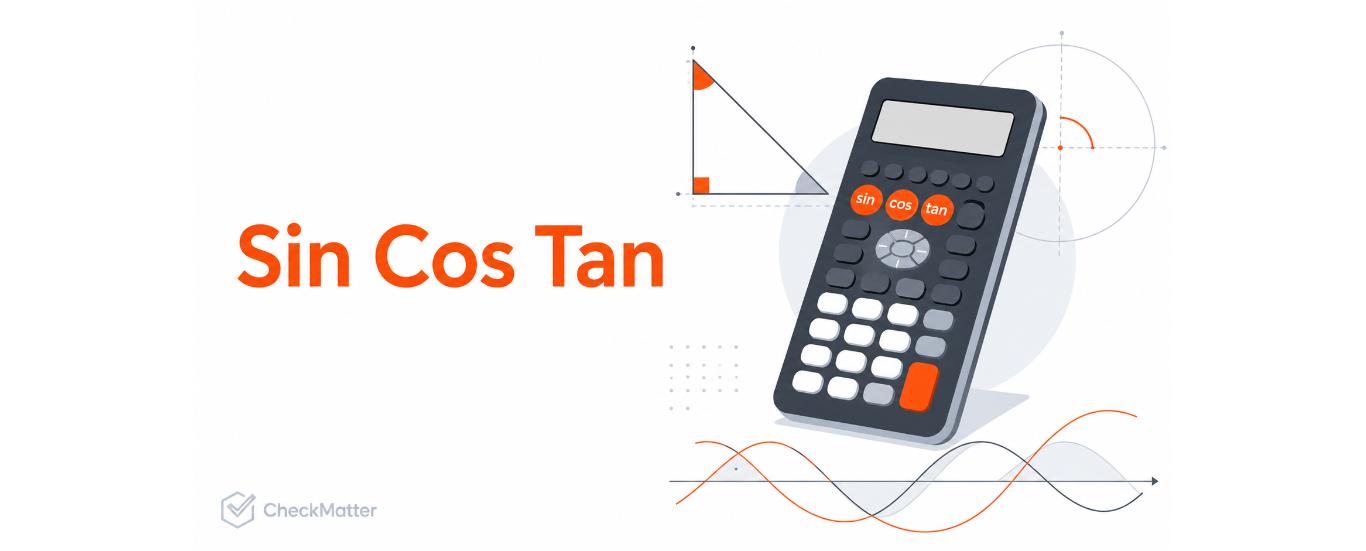
Every scientific calculator has three buttons that quietly power everything from architecture to video game physics: sin, cos, and tan. If you’ve ever stared at a right triangle homework problem, a construction blueprint, or a physics formula and wondered which button to press, this guide on how to use a sin cos tan calculator walks through the logic step by step — no memorized trig table required.
What Sin, Cos, and Tan Actually Measure
Sine, cosine, and tangent are ratios between the sides of a right triangle, defined relative to one of its non-right angles. For an angle in a right triangle: sine is the opposite side divided by the hypotenuse, cosine is the adjacent side divided by the hypotenuse, and tangent is the opposite side divided by the adjacent side. A sin cos tan calculator automates these ratios for any angle you enter, which is why the three functions appear together on every scientific calculator’s face. For the formal mathematical definitions, the NIST Digital Library of Mathematical Functions is a rigorous, freely available reference if you want to go deeper than a typical textbook.
Degrees vs Radians: The Setting That Breaks Most Calculations
Before you press a single trig button, check whether your calculator is set to degrees or radians — this single setting causes more wrong answers than any other mistake in trigonometry problems. Most everyday and school-level problems use degrees (a full circle is 360°), while higher-level calculus and physics often use radians (a full circle is 2π). Look for a small “DEG” or “RAD” indicator on the display; if your answer looks wildly wrong (like sin of a small angle returning a large negative number), the mode is almost always the culprit. CheckMatter’s Scientific Calculator lets you toggle between degrees and radians directly, so you can match whatever your textbook or problem set expects.
Step-by-Step: Finding a Missing Side
Say you know one angle of a right triangle is 30°, the hypotenuse is 10 units, and you need the length of the side opposite that angle. Since sine relates the opposite side to the hypotenuse, you’d set up: opposite = hypotenuse × sin(angle). Plugging in the numbers: opposite = 10 × sin(30°) = 10 × 0.5 = 5 units. The same pattern works for cosine (adjacent = hypotenuse × cos(angle)) and tangent (opposite = adjacent × tan(angle)) — you’re always just rearranging the ratio to solve for whichever side is unknown.
Step-by-Step: Finding a Missing Angle
Going the other direction — from side lengths to an angle — requires the inverse functions: arcsin (sin⁻¹), arccos (cos⁻¹), and arctan (tan⁻¹), usually accessed on a scientific calculator via a “shift” or “2nd” key combined with the sin, cos, or tan button. For illustration only: if a ramp rises 3 units over a horizontal run of 4 units, the angle of incline equals tan⁻¹(3/4), which works out to approximately 36.87°. This inverse-function approach is exactly how tools like CheckMatter’s Scientific Calculator let you go from measured distances to an actual angle in degrees.
Where These Functions Show Up Outside the Classroom
Trigonometry isn’t just an exam topic. Carpenters and roofers use tangent to calculate roof pitch and stair angles. Surveyors and civil engineers use sine and cosine to convert distance-and-angle measurements into horizontal and vertical coordinates. Physics problems use all three to break forces, velocities, or wave patterns into components. Even navigation and GPS systems lean on trigonometric functions to convert angles and distances into positions. Knowing how to use these trigonometric functions confidently is genuinely a practical, transferable skill, not just something you forget after a final exam.
Common Mistakes When Using a Sin Cos Tan Calculator
- Wrong angle mode. As covered above, mixing up degrees and radians is the single most common error — always check the mode indicator first.
- Mixing up opposite, adjacent, and hypotenuse. The “opposite” and “adjacent” sides are only defined relative to a specific angle — draw the triangle and label it before assigning ratios.
- Forgetting the inverse function. Pressing sin instead of sin⁻¹ (or vice versa) gives you a completely different type of answer — a ratio instead of an angle, or an angle instead of a ratio.
- Rounding too early. Carry extra decimal places through multi-step problems and round only your final answer, since early rounding compounds errors in longer calculations.
Key Takeaways
- Sin, cos, and tan are ratios of a right triangle’s sides, always defined relative to a specific angle.
- Always confirm degree vs radian mode before using a sin cos tan calculator — it’s the most common source of wrong answers.
- Use sin, cos, and tan to find a missing side; use their inverse functions (sin⁻¹, cos⁻¹, tan⁻¹) to find a missing angle.
- These functions have everyday uses far beyond the classroom, from construction to navigation.
FAQ
Do I need radians or degrees on my sin cos tan calculator?
It depends on the problem. Most school-level geometry uses degrees, while calculus and advanced physics typically use radians — check your textbook or problem statement and match your calculator’s mode accordingly.
What’s the difference between sin and sin⁻¹?
Sin takes an angle and returns a ratio; sin⁻¹ (arcsine) takes a ratio and returns an angle. They’re inverse operations, not interchangeable.
Can I use a sin cos tan calculator for angles greater than 90°?
Yes. The functions extend beyond right-triangle angles using the unit circle, and a scientific calculator handles this automatically as long as the mode (degrees/radians) is set correctly.
Where can I try this without a physical calculator?
Use CheckMatter’s free Scientific Calculator for instant sin, cos, and tan results, or browse the full tools directory for related calculators.
This article is for general educational purposes, with illustrative examples only. Always verify calculator settings against your specific coursework or professional requirements.